Sunday, 19 April 2020

Down time

Whilst I consider myself to be somewhat lucky so far as the corona virus goes I do have a bit more time on my hands and thought I would let you know the things that have been catching my attention on the TV and on youtube.

Pro Home Cooks on you tube and his blog  https://www.prohomecooks.com/blog/ He is calling himself Mike G on his blog and is well worth checking out.
I believe he and his brother had this channel until late last year when they decided to go their separate ways. I noticed his videos popping up in my feed and decided to check them out. He is clearly a really talented home cook and has an amazing set up. He has recently built a kitchen and is massively into sourdough and preserving foods including Kombucha. I watched one of his videos on using an air-fryer today and I am now going to have to give mine a rethink and a whole lot more air time (pardon the pun)   https://www.youtube.com/channel/UCzH5n3Ih5kgQoiDAQt2FwLw


My all time favourite in the digital age is Bangkok based Mark Wiens and his blog Migrationology.com. Mark is a legend of food tourism travelling usually with his Thai wife Ying to great normally budget friendly restaurants at home in Thailand and throughout the world. He comes across as a really genuine guy who just loves to eat and really buys into the stories of the places he visits. If you are not yet across his stuff the you need to make it a priority. I have just finished all 39 parts of his trip around the world sponsored by the star alliance family of airlines.   https://www.youtube.com/channel/UCyEd6QBSgat5kkC6svyjudA


As part of my food study I am also watching the series of public lectures by Harvard University on Scien
ce and Cooking put up on youtube so that we all have access. These though quite technical at times, are a great way to get access to some of the great chefs of the world and the science that is a part of their cooking.   https://www.youtube.com/playlist?list=PL546CD09EA2399DAB


I am also plugging through Jacob Burton's youtube channel a culinary school refresher course. Jacob really knows his stuff and is a great place for anyone who ever wanted to go to cooking school but missed the chance. His blog is  https://stellaculinary.com/chef-jacobs-culinary-boot-camp-f-step-curriculum and is full of useful cooking tips to lay a solid foundation for future cooking success.    https://www.youtube.com/playlist?list=PLpkj3Cc40ZCoMAoVI9OkjzMpj0PZkq5zL

On netflix I am watching The Chef Show which is a really cool take on the cooking show dynamic with Jon Favreau and Roy Choi taking you through some great recipes. The show is a spin off from the successful 2014 movie called Chef staring Jon Favreau as a chef who storms out of his job as a chef in a top notch restaurant and ends up cooking great food out of a food truck. Roy is a Korean American Chef who taught Jon the ins and outs of being a chef so that he could successfully play the roll of the chef in the movie. Clearly Roy's love of food rubbed Jon up the right way and they didn't want the fun to stop when the movie ended. The two of them with guests along for the ride are a great source of culinary inspiration. https://thechefshow.com/

Another great show I love on Netflix is Chefs Table which gives great incite into some really fine chefs from around the globe. Just in case you thought you were doing something stand out an episode or of this show and the Chefs Table France are there to show you just how far away from the top you really find yourself. Not to say that the show disheartens in any way. I love the window into the cooking of some masters of food.  https://www.netflix.com/au/title/80007945


I also try to catch the podcast of Milk street radio with Christopher Kimble. This guy is an inspiration in the world of food knowledge and home cooking wisdom. I have also signed up on the website https://www.177milkstreet.com/ for a free online cooking class. It is too early to say it will be great but I am keyed up to give it a try.

Thursday, 16 April 2020

A day in the Life of a Chef - Part 6

And on it goes ....
The steamed vegetables come out of the oven and go straight into the Baine Marie in a long oven tray. The steamer trays a perforated so that water doesn't pool in the base of the tray whilst you are steaming. Now it is time to put the Carbonara pizza into the oven. The pizza goes in for 8 minutes at 200C before turning and giving it another 5 minutes. This should prevent uneven cooking and give an even browning to the cheese and crust of the pizza.

A lid on the pasta water should speed up the boiling and have us ready to cook our ravioli. I will usually start with 2 or 3 packets of the ravioli which is cooked from frozen. Simply cut a corner off the packet so that you can control your pouring and tip into the boiling salted water. After about a minute I gently stir the pasta to prevent it sticking to the base of the pot. I would then cover with the lid to bring it back to the boil. As soon as it does remove the lid wearing a heat resistant glove or a tea towel in hand and stir a second time to again prevent sticking. The pasta should now be right to boil away until cooked. If the pasta sauce had reached a good thick consistency earlier in the morning I would have turned the heat off. If this is the case I would reheat in at a gentle heat turning it back on just prior to putting the pasta on to cook. This should mean that when the pasta is ready the sauce is also hot. When the pasta is cooked (the manufacturer usually knows their product so check the packet and taste the first time you use a new brand) use a handled colander to scoop the pasta into a large bowl on the side. Add in about ten large ladles of pasta sauce, scooping deeply to get plenty of the good ingredients which are by now no doubt nestling on the base of the pot. Also I make sure I take the last few ladles from the top to get a good balance of sauce and chunky ingredients. I will also throw in a bunch of fresh parsley and a big handful of Parmesan cheese and mix with a kitchen spoon to incorporate everything thoroughly. This is then poured into an oven to tray and transferred to the Baine Marie. The other point to note is that when it comes to pasta I use more sauce than I would if I was serving immediately due to the evaporation that occurs whilst the sauce sits in the heated environment of the hot baine. This hopefully prevents it looking dry when the customers come to eat.

The Pizza should now be ready and slid onto a fresh white chopping board to cut into 8 even pieces. After cutting slide the pizza back onto the flat tray it was cooked on and into the hot baine to await service. In the case of the flat trays I always put a perforated steamer tray underneath them in the hot baine to prevent the tray from sliding into the hot water below. Better safe than sorry.

The last item to add is our chicken Vindaloo. The Brat pan is tilted enough so that the curry tips onto an angle that allows me to get a smallish bowl in to scoop the curry into an extra deep oven tray. In my early days I used to scoop the curry into a deep tray that held just over half the curry and then had to reheat the rest during service but have not decided that it is easier to put it all out the front right from the start. That bit is actually fairly obvious, but I always had concerns about the quality issues related to putting the whole curry up for the entire lunch session. I now believe that the pay off outweighs any loss of quality in relation to the food in most wet dishes.

I used to push hard to try to get myself a lunch break but these days I have decided that the time is better spent finalising my paperwork from the mornings cooking and hopefully getting my ordering list written up. What paperwork does a chef do? In the modern kitchen it is essential that we keep record of temperatures of food we cook and do some checking of goods received to make sure that they are in date, held at the correct temperature and of appropriate standards for use in our kitchen. Some of this needs to be written up to help with compliance with both the council food hygiene inspectors and the even more critical internal auditors from my own company. Everybody has a job to do in this area and it is just part of a modern workplace. Whinge about it if you want, but as is the case with many things in life it is usually easier just to get on with it.

Writing this now I feel as I do at work where getting up to this part of the day, that being the start of service, I feel like the work is done. Which I think is a little strange and partially a result of working in a non Ala-carte kitchen.

We do share the paperwork around so that everyone in the kitchen has some to do, but as you would expect most of it is left to the chef. I need to record all the goods received and a temperature of a sample of any high risk foods. I also need to record the cooling temperature of one item a day. That may be the eggs we steam for the sandwich bar or any leftover food from the hot baine that we intend to reuse, perhaps an example would be chicken leftover on roast chicken day.

I believe brings to the end of morning service  with only Lunch service and clean up to come. But that's for another time. Until then happy cooking!!!

Friday, 10 April 2020

A day in the life of a Chef - Part 5

Last addition I left you after commencing the salad of the day, a Roast Zucchini and haloumi cheese salad. To get on with the salad I would first of all dice up a couple of flat trays worth of zucchini and 800 grams of haloumi cheese. For those of you unfamiliar with Haloumi, it is a grillable, I think Greek cheese, which is a fantastic addition to your next nibble's platter. It comes in 200 to 250 gram blocks, similar to Feta cheese. Slice into half centimetre slices and pan fry over medium heat until nicely browned on each side. At medium heat this is not a pan to walk away from as you will end up with burnt Haloumi in no time at all. Cooking time <5 minutes.
Anyhow, back to my salad. As I am in most aspects of the job looking to save hands on time I will dice up the Haloumi into rough 1 cm dice and place on a flat tray covered with greaseproof paper and sprayed with canola spray to help browning. The cheese would go into a 170 oven for 10 minutes and the Zucchini a 200 oven for 10 minutes also. Base salad ingredients are washed and drained the put into a large stainless steel bowl. Tomatoes are diced, cucumbers are diced both in approximately 1 cm dice. Remember this is not fine dining so when I say 1 cm dice I mean a rough dice that is dependant on my mood and the size of the tomato and cucumber. Capsicums are cut and sliced by removing the 4 sides and then removing the white membrane from the inside. the base and the bit of capsicum around the stem is also used so that we waste almost nothing. The Spanish or red onion is peeled and either finely sliced or finely diced. I am not a fan of chewing on large chunks of raw onion so my customers shouldn't have to be either. When the Zucchini and Haloumi have both cooled at least partially they are tossed in with the rest of the salad. I then mix together a quick vinaigrette by adding 210 ml of olive oil with either 70 ml of Balsamic or red wine vinegar and some Dijon mustard to emulsify the dressing. I season the salad with salt and vinegar and toss the salad together by hand whilst wearing food safe gloves. The salad is displayed for service in an old ceramic white baking dish and should serve close to 20 customers. One thing I will say here is that I feel that it is vital to the salad presentation that I transfer the salad in double handfuls from the bowl to the serving platter by hand as this gives the finished product greater height than basically tipping it out onto the tray. Also, a little thing I have noticed as a benefit of tossing salad in a bowl before serving on another platter is that the heavier foods generally fall to the bottom of the bowl. In turn this means than when you plate them they then naturally end up on top and enhance the presentation. Give it a try next time you make a salad at home.

Next step, I move onto the Chicken Vindaloo. I really don't know how close to a real life curry this one is to be completely honest. I make the curry using 15 kg of diced chicken thigh and usually commence cooking after 9 am which means even if the curry is unlikely to spend too much time in the food temperature danger zone. If I start cooking at around 9 am with service completed at 1.30 pm I will have reduced the time the food will spend in the temperature danger zone to a minimum. So on to the cooking. First up I turn on the brat pan which is a standalone giant cooking vessel. Our one at work uses gas to operate but they do also come in electric too. A brat pan is a God send in a commercial kitchen like mine as it allows me to cook all my wet dishes and I also utilise it for large stir fries. When I say wet dishes I mean things like curries and braised dishes like stews and casseroles.

Okay, enough waffling, lets get down to the business of cooking the main dish of the day, Chicken Vindaloo. First thing, turn on the brat-pan to high heat. Dice roughly about 4 large brown onions. Add canola oil, generous amount and then the onions. Then grab the 15 kg of diced thigh from the cool room and tip it into the brat-pan. Spread the chicken with my 2 large spatulas evenly across the base of the pan. This if I have left enough time for the pan to heat sufficiently and if I then don't try to stir the food too soon with allow at least some browning which won't as once suspected seal the meat but is still an essential part of searing the meat which should add flavour. Having said that, I have observed that in many Asian countries it is common practice to add the meat after a sauce has been created so that the browning is not part of the cooking process. There are also examples of European braised dishes which also do not include browning of meat so one should be careful in making wholesale generalisations. After I have added the chicken I will then use a Jar of Vindaloo paste which saves time and effort and probably money too. The entire jar which is just over a kilogram in weight is added to the chicken and onion and mixed in to incorporate. My approach from here may be as simple as loosely following the recipe on the side of the packet and often boosting the important flavours of the curry by adding extra Garam Masala (an Indian spice blend) or some ginger, garlic and other Indian spice regulars like cumin, cinnamon, coriander and chilli.

This particular curry is known for being a hot curry so I think it is essential to give the customer a hot spicy curry when that is what they expect. The other option I have often tried to implement is giving a small bowl of chilli to the front of house so that the spice lovers can add chilli to fire up their curry whilst leaving the curry less fiery for the rest of the crowd.

From memory the side of the packet asks for tinned tomato and stock to round out our curry. After adding a couple of kilos of tomato and around 4 litres of water with stock powder added I will reduce the heat and allow the curry to simmer away in it's own time.

So at this point of the day it is hopefully around 10 am and time to finish the cooking and transfer our completed dishes to the Baine Marie for lunch service which commences at 11.30 am. First thing to do is get the rice which has been cooling, into the oven for steaming for 10 minutes. Prior to putting into the oven I will run my gloved hands through the rice to help separate the rice which whilst cooling will have clumped together. After 10 minutes steaming I will test the rice's temperature with a probe in 3 different parts of the tray to test that it has reheated to the correct temperature (>75C). If achieved I will take the tray to the Baine Marie and cover with a lid to stop drying out the top layer of rice. If not quite hot enough I will rotate the tray and steam for an extra 5 minutes and retest.

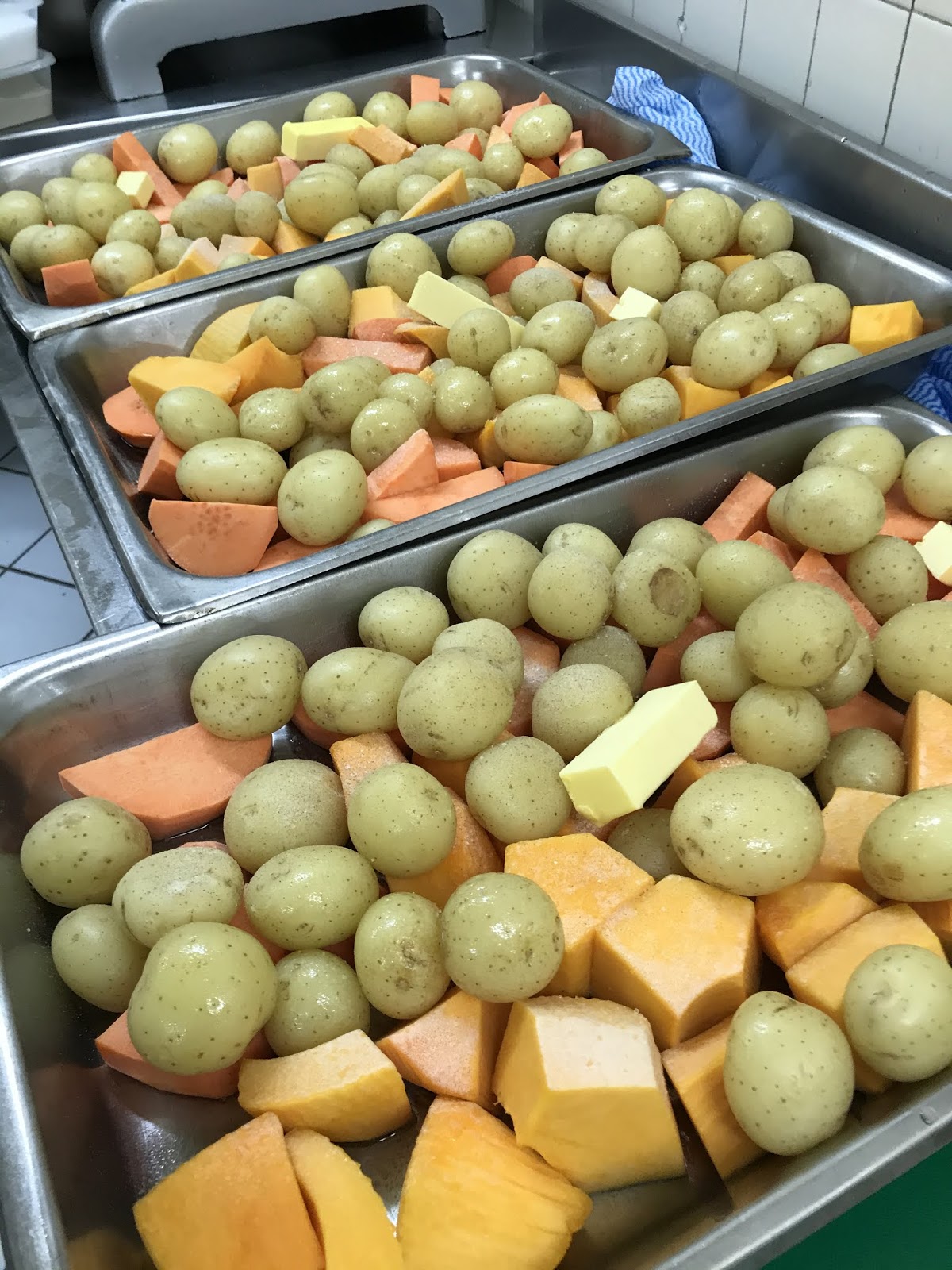
Whilst the rice is cooking I will continue to stir the curry to prevent it catching on the base of the pan and also stir the pasta sauce if it is still simmering away. Speaking of the pasta, it is now time to fill a pot with water so that the ravioli can be cooked. To reduce time I will half fill the pot with boiling water from the Zippo water heater in the corner of the wash-up room and top up with cold water from the tap. To this add a generous amount of salt and top with a lid to speed things along. Next into the oven on this day is steamed vegetables. The vegetable mix is a base of fresh broccoli, cauliflower, carrots and zucchini with additions of frozen peas, beans, corn on cob and bok choy. I rotate between the additions so that hopefully the mix doesn't get too predictable. The first batch of the day is generally steamed for 7 minutes and later batches boiled on the stove-top to prevent a build up of items wanting oven time during service.

Time is up for today, as I am currently on Easter break and taking a little extra leave due to the Corona virus Pandemic I am only at work for 2 of the next 10 days so hopefully I will be finally knocking over this day in the life series and am thinking of putting up a couple of recipes as well. For now though, Happy cooking!!! Where else would you prefer to spend your isolation than in the kitchen??? 


Saturday, 4 April 2020

A day in the life of a Chef - Part 4

shallots
Continuing on with the Carbonara pizza. I have spread the bases with the Parmesan white sauce and will dice up 16 rashers of middle bacon and flash them through the oven for 10 minutes at 180 degrees Celsius to make sure that they are cooked but not crunchy when the pizza is cooked. I slice up mushrooms to top the pizzas and chopped the shallots. I will then top the pizzas with the mushrooms and shallots as well as the now cooked diced bacon. To finish off the pizza I will top with a generous quantity of mozzarella cheese. Pizzas are now cling wrapped and put into the coolroom until it is time for them to cook in a 185 oven for 13 minutes tuning tray after 8.

Moving on. Through out the morning deliveries with need to be checked and signed for as well at put away. Monday is a busy day for deliveries with vegetables, usually a box of tomatoes, a box of cauliflower and zucchini, broccoli and 15 kg of carrots as well as a kilogram of baby spinach, some iceberg lettuce and 2 or 3 kilograms of mesclun or mixed lettuce are some of the items that may be arriving. Under normal circumstances we receive vegetables 3 days a week on a Monday, Wednesday and Friday.

Also, on Monday, Tuesday and Thursday we receive our dry, refrigerated and frozen goods from another supplier. These are packed away by myself and the manager. These deliveries are placed the working day prior and delivery is made around 8 o'clock in the morning. This delivery includes a box of frozen chips 15 kg, pasta 10 kg dry usually penne or spaghetti or frozen 1 kg ravioli, rice 10 kg bags, grated and sliced cheeses, 15 doz eggs in a box, 2.5 kg packets of bacon averaged out to approximately 1 pack a day and much more.

Monday is also meat delivery day for the week, so all the red meat I need for Tuesday to Thursdays menus arrives at around 11 am. The includes 20 to 25 kilograms of meat for Thursday's roast which rotates between Beef, Lamb, Chicken and Pork. If I have chicken on Tuesday's menu then a chicken delivery will also arrive Monday morning.

Moving back to lunch preparation , next on the agenda is the sauce for the Spinach and ricotta ravioli which is a simple Mushroom, sun-dried tomato, and pesto cream sauce. I would dice onions and rough chop the mushrooms, and sun-dried tomatoes. The mushrooms I like to chop in largish sizes so that they don't completely breakdown and disintegrate during cooking. The large pot is heated for about a minute before adding oil from the sun-dried tomato jar and the onions are simmered for 4 or 5 minutes to get some flavour into them. Then I add the mushrooms and sun-dried tomatoes, a good spoon of crushed garlic and cook until browned and ready to add some white wine ( a cup or two) to bring out the flavours. After the wine reduces I add in half a kilo of crushed tomatoes and 2 large kitchen spoons of jarred pesto sauce. Give it a good stir with the spoon to stop the ingredients catching on the sides, season with salt and pepper, and add around 4 litres of thickened cream. From this stage I just need to keep an eye on it whilst it simmers away and reduces and I move on with my next job.

And speaking of that job, it is the making of a roast zucchini and haloumi salad. I have somewhat standardised my salads of late by building a base of a large handful of mesclun, half a dozen tomatoes, 3 large cucumbers, a red and a green capsicum, a Spanish onion, and a grated carrot of 2. On top of this base I add the main ingredients of the salad, in this case Zucchini and Haloumi cheese.

Time to grab a morning coffee, this is to be continued. Happy eating and stay safe!!

Tuesday, 31 March 2020

A day in the life of a Chef - Part 3

As well as the regular breakfast items that are cooked each day I also do a special item. Special is in truth a little generous as a descriptive as the items are the same for their day of the week. Monday is French toast, Tuesday is a sausage roll, Wednesday is eggs Benedict, Thursday is Ham, cheese, tomato Turkish melt and Friday is Scrambled eggs. These items are cooked either alongside the other breakfast items as with the sausage rolls or after the other breakfast has been transferred to the Hot baine as is the case with the scrambled eggs.

From here I swing into lunch cookery and preparation. Breakfast cooking runs from 7 am until 10 am but in reality I only have to cook a few pans of eggs or put another half dozen hash browns into the fryer or on busier days put another tray of bacon into the oven. If I am lucky the the other staff will jump in, provided they have time and cook the eggs or hash browns. The key for me is to not pay too close attention to the way they do it and to accept that not everything will be done exactly the way you would like. 80% is good enough and all help is good help.

For this purpose I have grabbed an old menu from a random Monday and will run through how I would have cooked and prepared the food. On a Monday morning the sandwich bar requires hard boiled eggs, some will be displayed as whole peeled eggs and other mashed up from egg salad sandwiches. I am required to steam 2 trays or 60 eggs for 14 minutes in the combi oven. I do this as soon as the oven is free of breakfast foods. The other thing I am always careful to do when switching between oven cooking and steaming is allowing the oven to cool to below 80 degrees Celsius before steaming an item. This means that the steam with start almost immediately and also stop the oven baking the item that I am attempting to steam. The biggest problem items for this are when I am steaming rice up to heat for service and vegetables. The top of the rice can become crunchy if the oven is too hot and the vegetables with burn which is not what you want from your steamed veggies.

The other thing that usually occurs at this time of day is the arrival of the milk delivery. I am usually required to send our dumb waiter (goods lift) down so the driver can load the milk onto a trolley in the lift. Once done I will call the lift up and with the assistance of the manager load the milk into the coolroom. Milk deliveries come on Monday and Wednesday and on a typical Monday there are 9 crates of milk to unload.

From here I continue on with my work. The eggs are transferred to a sink in the washup room and covered with water and ice to chill them as rapidly as I can so that I can record the cooling being successfully completed within four hours. The catering assistants with peel the eggs during the morning for their use in the sandwich bar.

I then fill an oven tray with around 3 kg of rice, usually jasmine rice from Thailand. The rice is rinsed for about a minute under running water and then covered with approximately 3 litres of water. I find that the steam adds water during the cooking process so I don't add quite as much water as I would if using a rice cooker. The oven is set to steam and 20 minutes on the timer. The rice for this particular day was to accompany Chicken Vindaloo. Vindaloo is a spicy Indian curry that contains no cream or coconut cream to help balance it's natural heat. When the rice comes out of the oven it will be divided in half into a fresh tray and moved to the top shelf of the coolroom to chill. I have found the part of the coolroom where the cooling fan blows and put the foods I wish to cool on the shelf to assist in rapid cooling.

Next item on the agenda on this particular day would most likely have been to take the pizza bases out of the freezer. The pizza bases are slab sized which fit perfectly to the size of my 4 flat baine trays.
The pizza of the day is Carbonara pizza which is from a recipe that I found in my company's quarterly food magazine. It has a Parmesan cheese white sauce base and is topped with  bacon, mushrooms, shallots and Mozzarella. I would now jump into making about 2 litres of white sauce by first measuring and melting 200 grams of butter and whisking in 200 grams of plain flour and gradually whisking in the 2 litres of milk. Bring to a boil and reduce heat to thicken. After removing from heat add in the Parmesan. Spread over the 8 pizza bases which should serve 32 people.

Anyway, it's time for me to get the dinner on the table. Until next time, happy cooking!!


Sunday, 15 March 2020

A day in the life of a chef - part 2

Sorry for the wait for part 2. Continuing on with breakfast preparations.

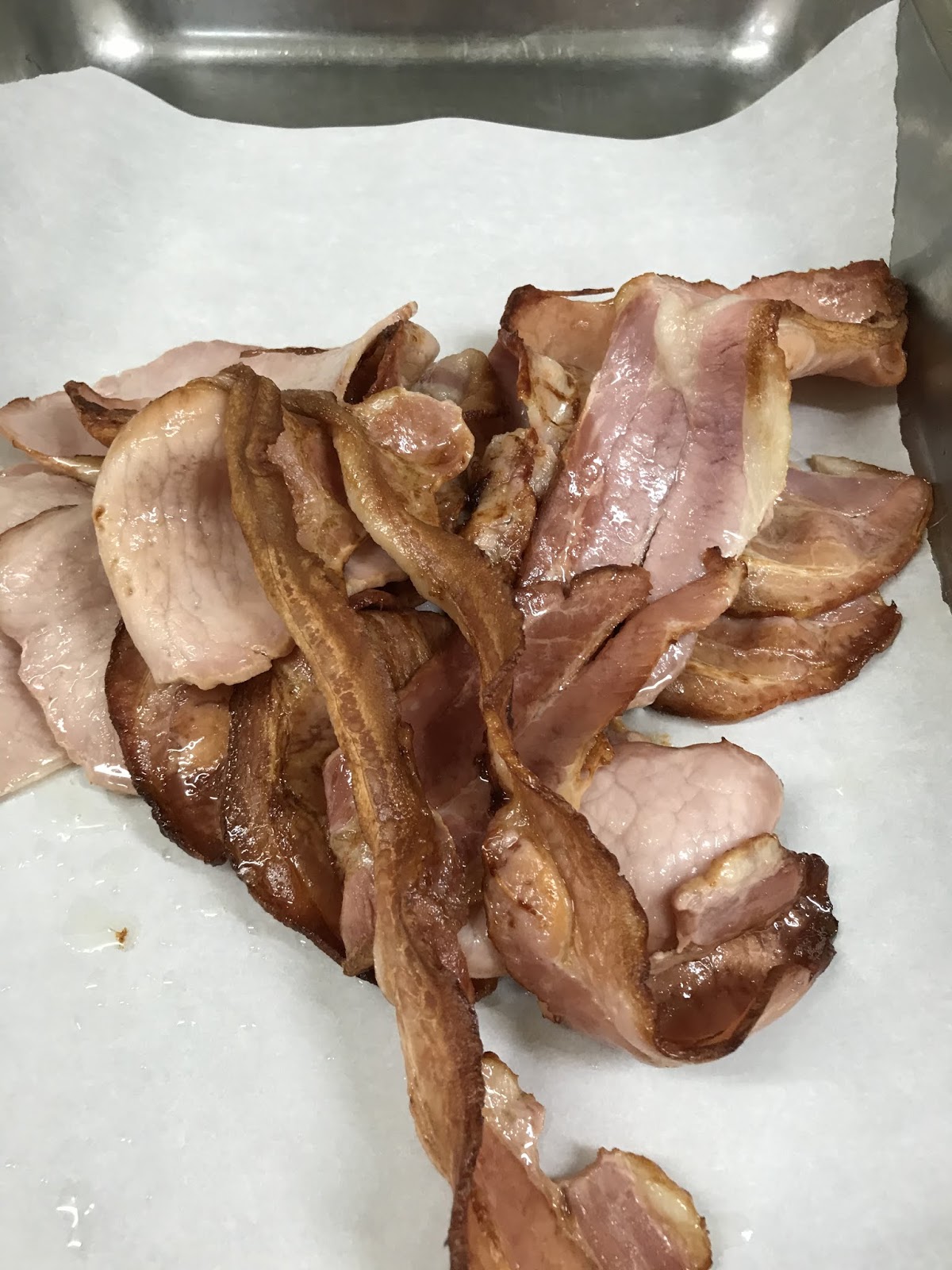
It is now approximately 6.25am. I turn on the heat under the fry-pan to a low to medium heat to preheat the pan before returning to the cool-room to get the sausages to put into the pan for cooking. I only cook between 5 and 9 sausages for the breakfast depending on the usual business of the day. The breakfast gets busier as the week goes on so I cook less earlier in the week and increase numbers as we get closer to Friday. By turning the pan on and then going to get the sausages I allow the pan to preheat a little before adding a little oil and the thin breakfast sausages. The sausages with fry in the pan for approximately 5 to 10 minutes before being added to the oven for 6 minutes to finish cooking. When removing from the oven I will test doneness by inserting a probe into the thickest part of the middle sausage. I tray the bacon. I place nine rashers on each of 3 large trays and 7 on a smaller tray as a backup. The backup tray in cling wrapped and put back into the cool-room to be used if needed. I use our older trays for this as we will not need them later in the morning and also they conduct heat better than the newer stainless steel trays. By this stage the oven is preheating nicely and I put the 3 trays into the oven to cook. In my time at my current site the grill plate has never worked and there have been occasional whispers that a replacement will be installed but this little Chef is not holding his breath. Without a grill the oven is the best way to cook the bacon in my opinion. After putting the bacon into the oven I wait for the the temperature to come back up to 190 Celsius before adjusting the timer to 15 minutes remaining.

Whilst waiting I get 4 tomatoes from the cool-room, selecting the best available, usually that means the biggest and reddest. I remove the core with an upturned paring knife and halve the tomatoes horizontally. They are put into a half size baking tray and put into the oven for 8 minutes. I then get the hash browns from the smaller freezer and put 6 of them into a fryer basket ready to drop into the fryer when the hash browns have 3 minutes remaining on their cooking time. When the tomatoes are cooked I will add the hash browns to the same half tray and take them to the baine marie. By this time the manager will be in and will have filled the baine marie with hot water and turned it on to maximum heat so that it is ready to keep the breakfast food at the correct temperature. That usually for us is above around 70 degrees. The browned and finished in the oven sausages should be ready around this time also and their half tray is placed in the same slot as the tomato tray in the hot baine. I will also start to pan fry eggs at this time. I again preheat the pan on low for about a minute, add a little canola oil and then the six eggs to the pan. I will do 12 eggs to start us off. Six will be sunny side up and six flipped and cooked to a firm consistency. The eggs are transferred to a long oven tray and put into the first place in the hot baine. They are covered with a plastic lid to reduce drying out.

Around this time the oven will be buzzing to let me know that the bacon is ready. I will get the bacon from the oven using either heat resistant gloves or tea towels to prevent burning my hands and move the bacon into another long tray to be placed in the hot baine alongside the eggs. The oven trays are covered with greaseproof paper to made clean up easier and initially the trays are put into the wash up room with the paper still on as they a now covered in hot fat from the cooked bacon. When the trays cool enough to solidify the fat it and the paper will be put into the garbage. To do so when still hot would result in a garbage bag full of holes.

Until next time happy cooking and eating!!!


Tuesday, 10 March 2020

32 Yolks by Eric Ripert

I recently completed reading this fantastic book by French born and trained chef Eric Ripert. Eric is the chef and co-owner at the famous New York restaurant Le Bernardin and initially came to my attention as the very good friend of the late great Anthony Bourdain. Eric if I remember rightly is the person who found Tony's body on that fateful day in France that shook the foodie world or at least the English speaking parts of it.

 This great book is one for the true believers. An amazing incite into the childhood, at times distressing and early cooking career on Eric. How much do I tell without ruining the reading? Hopefully, if you're lucky, just the right amount.

 The book starts out telling of Eric's childhood and his parents' marriage breakdown. He talks about eating in high quality restaurants with his mother and about appreciating good food early in life. He talks about staying with grandparents who gave him different views of great cooking and eating. He then tells of the difficulties of growing up after his mother starts living with a good for nothing guy who treats Eric abusively before having him shipped off to boarding school. Eric, his mother and good for nothing move to Andorra and it is here that Eric comes across a Chef who allows him access to his kitchen and food and gives the inspiration to become a chef.

 He loses his father to an untimely death and suffers though and survives more difficulties at school. All the while his extremely hard working mother continues to put food on the table through her clothing stores. From there his life heads as we should expect to culinary school where despite a table waiting disaster young Eric makes his way through and into the only three star Michelin restaurant to respond to his 18 sent resumes.

 La Tour d'Argent is where he meets Maurice a chef who shows him by methods that could be kindly described as tough learning. This is early 1980's or late 1970's Paris after all, would we expect any less. Whilst the early parts of the book told a nice story it is from this point on that had me not wanting to put the book down. The incites into life in fine dining restaurants in arguably the greatest culinary city of them all is as close as we can get without having lived it. The restaurant is so old that it was mentioned in the Marcel Proust classic Remembrance of things past which was published between 1913 and 1927. Eric spends a year and a half at La TourTour d'Argent and learns to become a chef. The chefs there teach him and although their methods are not for the weak they do give him the foundations that he can build on in his career. The head chef Bouchet sends him off to work at the most cutting edge restaurant in Paris at the time to work with one of if not the finest chef in the world Joel Robuchon.

 In this part of the book I want to read more and more but I also want to slow down because I don't want it to end. The dramas of his life to this point are nothing compared to working for an amazing genius. The Chef he started with at La Tour d'Argent is already there waiting for him and greets Eric with a "are you following me Ripert?" on seeing him arrive for work at Jamin. Jamin was only open Monday to Friday, but young Eric worked from between 6 or 7 in the morning until after midnight and slept the first day of the weekend to recover. The other day, Sunday was spent practising. This is where his greatness is born. Robuchon has a vision and passion that only a genius can. I loved the fly on the wall stuff here.Not sure where you grab a copy buy definitely get your hands on one.

 From Jamin, Eric does a year of Military Service and then amazingly returns to Robuchon for another stint in hell. He meets a girl and whilst on Military service and enjoys learning about food from her I think uncle in rural France. At the end of his time a Jamin he ends the book but heading off to the USA and life begins again. I think there is another book for him to write.

 All in all a wonderful book of only 247 pages. Loved it to bits. Want to find out what 32 yolks refers to? Read the book. There is so much more inside this wonderful excursion into early 80's Parisian kitchen life, A must read.

Love's Kitchen

  I was doing the regular scan of Netflix and Prime video on Saturday night and found this "food movie"  on Prime. The story is ab...